
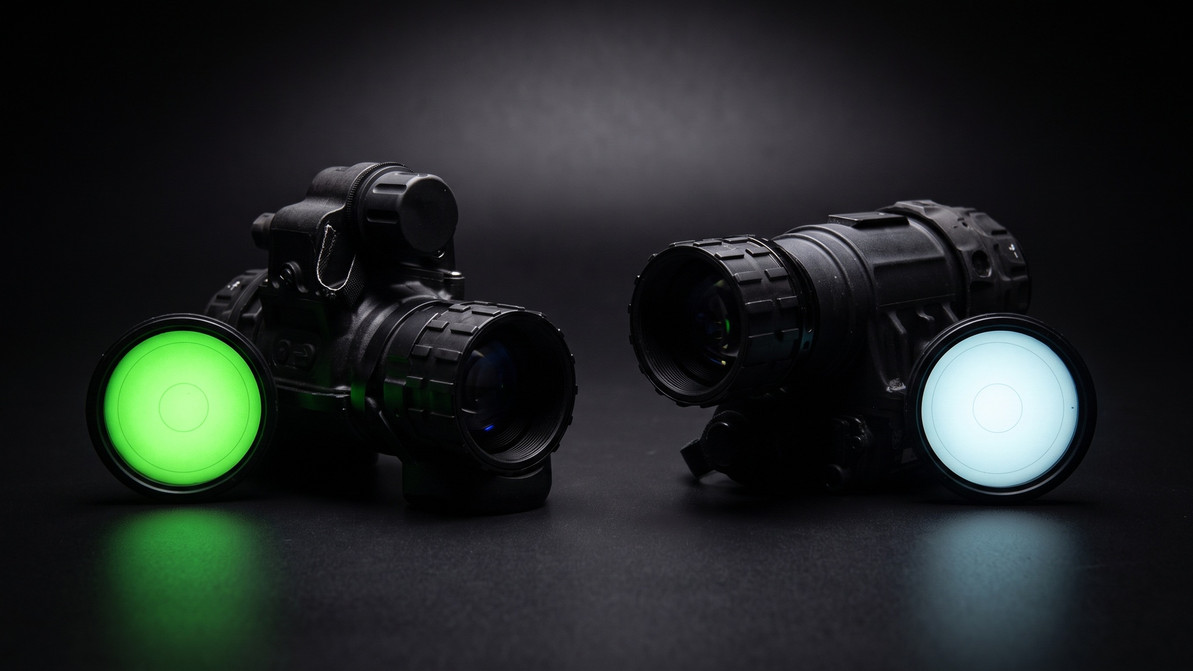
White Phosphor vs. Green Phosphor: Is Green Obsolete?
For decades, green phosphor was the undisputed symbol of night vision. From early military operations to Hollywood action movies, Green Phosphor (GP) was the standard. But if you look at the industry today—and browse the premium inventory at US Night Vision—the conversation is almost entirely dominated by White Phosphor (WP).
With the rapid rise of WP tubes from top-tier manufacturers like L3Harris and Elbit, a massive shift has occurred in the night vision market. Many buyers are left asking: Is Green Phosphor obsolete? And more importantly, why are the prices of Green Phosphor starting to rival White Phosphor?
Let’s break down the reality of the market, the science behind the screens, and how global supply and demand are radically changing the way you buy night vision.
The Rise of White Phosphor: A Domestic Standard
In the United States, the transition to White Phosphor was less of a slow evolution and more of a rapid takeover. Over the last decade, U.S. Special Operations, domestic law enforcement agencies, and the civilian tactical market overwhelmingly adopted WP as their prominent first choice.
There are very real, biological reasons for this shift:
Contrast and Detail: White Phosphor produces a black-and-white (or slightly bluish-white) grayscale image. The human eye is naturally wired to process grayscale imagery and contrast much faster than single-color (monochrome) images. Shadows appear deeper, terrain features are easier to distinguish, and overall depth perception improves.
Reduced Eye Fatigue: Operators consistently report that looking at a White Phosphor screen for long durations causes noticeably less eye strain and fewer "night vision headaches" compared to the harsh glare of traditional green.
Because of these distinct advantages, White Phosphor became the undisputed premium choice for domestic buyers.
The Green Phosphor Reality: An International Stronghold
While the U.S. market pivoted hard to White, the transition for many international and allied end-users has been much more incremental. Overseas militaries and global agencies still rely heavily on Green Phosphor.
Green (P43) phosphor still boasts massive benefits. The human eye is incredibly sensitive to shades of green, allowing it to pick up micro-details and movement in dense brush environments exceptionally well. Furthermore, because entire foreign fleets of night vision and established training protocols are already based on green tubes, it is often logistically easier for international end-users to continue buying and training with GP.
The Economics of Night Vision: Supply, Demand, and Rising Costs
Here is where the market gets complicated for the everyday buyer. A common assumption is that because Green Phosphor is the "older" technology, it should be vastly cheaper than White Phosphor. Historically, that was true. Today, the math is changing.
As the domestic market rapidly ramped into demanding White Phosphor, manufacturers pivoted their production lines. When factories prioritize making WP tubes, they inherently make fewer GP tubes.
This creates a fascinating economic shift in the market:
The High Cost of Low Production: Because manufacturers are producing Green Phosphor in much smaller batches, they lose the economic benefits of mass production. The cost to manufacture GP is trending higher than ever before.
Dwindling Domestic Stock: As domestic stock and demand for GP dwindle, the remaining tubes become harder to source. As basic economics dictates, when supply drops significantly, prices go up.
The Price Convergence: We are now reaching a point where the cost of high-quality Green Phosphor is meeting—and in some specific cases, exceeding—the cost of White Phosphor.
The Performance Gap: Why Volume Matters
The shift in manufacturing volume doesn't just affect the price tag; it heavily dictates the average performance specs you see on the market today.
Image intensifier tubes are manufactured in batches, and every tube comes off the line with slightly different specifications (FOM, SNR, Halo, etc.). Because the industry is pumping out White Phosphor tubes by the tens of thousands, the statistical law of averages means there is an abundance of ultra-high-spec WP tubes available in the marketplace. When you buy White Phosphor, your statistical chance of getting a phenomenal performer with an elite spec sheet is exceptionally high.
Conversely, because far fewer Green Phosphor tubes are being made, the pool of available tubes is much smaller. Consequently, the relative average performance of available GP tubes tends to be lower than the massive pool of WP tubes. While "unicorn" high-spec Green Phosphor tubes certainly still exist, they are becoming much harder to find simply because fewer are being made overall.
The Verdict: Which Should You Buy?
So, is Green Phosphor dead? Absolutely not. But the way you shop for it has changed.
When to Buy White Phosphor: If you want the absolute zenith of modern performance, the highest statistical chance of getting an ultra-high FOM tube, and you want to reduce eye strain during long operations, White Phosphor easily justifies its premium price tag. It is the modern standard for a reason.
When to Buy Green Phosphor: If you are a traditionalist who prefers the high-contrast green for spotting movement in the brush, or if you are looking for a valid budget alternative where you can accept a slightly lower average spec range to save cash, Green Phosphor remains a highly capable, combat-proven tool. It serves as a fantastic entry point into professional-grade Gen 3 night vision.
At US Night Vision, we believe in giving you the choice. Whether you are chasing the highest-spec Unfilmed or filmed White Phosphor on the market, or looking for a reliable Green Phosphor PVS-14 to start your night vision journey, we have the inventory to support your mission.
Understand the market. See the difference. Browse our extensive lineup of White and Green Phosphor systems at US Night Vision today.
Recent Posts
-
Bump vs. Ballistic Helmets: Ops-Core and Team Wendy Guide
Let's Talk About Helmets: Bump vs. Ballistic (What Do You Actually Need?)You’ve finally done it. You …28th Aug 2026 -
The AI Revolution in Night Hunting: Inside the Nocpix RICO 3 PRO H50R
For the last decade, the evolution of thermal imaging has been mostly a numbers game: higher resolut …27th Aug 2026 -

The Night Ops Ecosystem: What to Buy First—Night Vision, Thermal, or a Laser?
One of the most common—and most difficult—questions we field at US Night Vision is: "I finally have …13th Aug 2026