
The Night Ops Ecosystem: What to Buy First—Night Vision, Thermal, or a Laser?
One of the most common—and most difficult—questions we field at US Night Vision is: "I finally have the budget to upgrade my low-light capabilities. What should I buy first?"
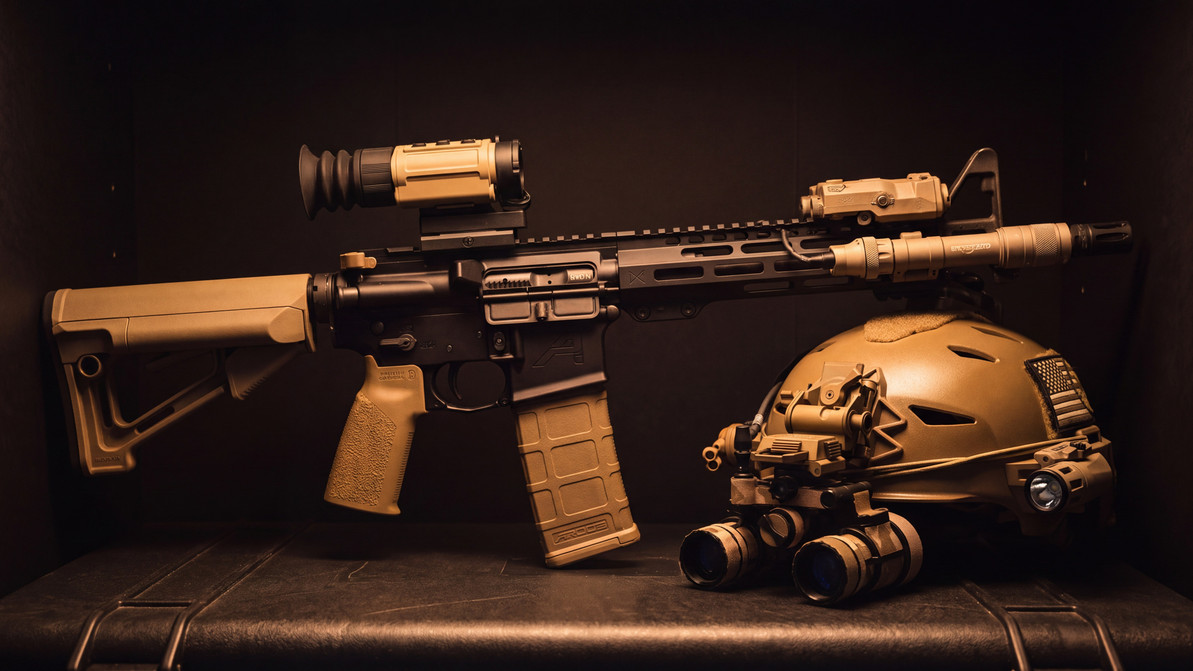
Usually, the buyer is staring at three distinct pieces of technology: Night Vision Goggles (NVGs), Thermal Imaging, and Infrared (IR) Lasers.
The internet is full of fierce debates over which technology is “best.” But the truth is, comparing night vision to thermal is like comparing a steering wheel to an engine—they do entirely different jobs. There is no universal "first" purchase. What you buy first relates almost entirely to your specific goals and the exact situations you expect to face.
Furthermore, to truly own the night, you will eventually realize that these are not competing technologies. They are complementary tools within a larger tactical ecosystem. In many cases, multiple tools are needed to eliminate the blind spots of the others.
Let’s break down what each tool does, why you might need it first, and how they ultimately merge into one unstoppable kit.
- Night Vision Goggles (The Navigator)
Analog night vision (like a Gen 3 PVS-14 or an ARNVG dual-tube setup) amplifies ambient starlight and moonlight. It operates exactly like your natural eye, providing a high-resolution, zero-latency view of the physical world in front of you.
- When to buy it first: If your primary objective requires movement and situational awareness. If you need to hike over rugged terrain, drive an off-road vehicle without headlights, clear a structure, or survive a grid-down (SHTF) scenario, you must have night vision.
- The Limitation: Night vision cannot magically see through thick brush or heavy fog. If a target is perfectly camouflaged and holding still in the dark, NVGs might miss them.
- Thermal Imaging (The Detector)
Thermal imaging devices (whether handheld scanners or weapon-mounted scopes) do not rely on light. Instead, they detect micro-variations in heat signatures. Where the human eye sees only blackness, a thermal sensor sees a glowing, unmistakable beacon of life.
- When to buy it first: If your primary objective is finding and eradicating. If you are a farmer doing crop-damage control on feral hogs, a predator hunter dealing with coyotes, or conducting static Search and Rescue (SAR), thermal is king. It allows you to instantly spot body heat through tall grass, light brush, and total darkness.
- The Limitation: Thermal cannot see through glass (like a window or a windshield). Because it detects heat rather than light, you lose natural depth perception and fine environmental details. You cannot safely drive or navigate treacherous terrain while looking through a thermal screen.
- Infrared (IR) Lasers (The Communicator)
An IR laser/illuminator unit (like the DesignateIR-V™ or Holosun IRIS) mounts to your rifle. It emits a laser beam and a flood of IR light that is completely invisible to the naked eye, but shines like a beacon when viewed through Night Vision Goggles.
- When to buy it first: Truthfully, an IR laser should never be your very first purchase, because without NVGs to see the beam, the laser is useless. However, the moment you purchase a helmet-mounted night vision system with the intent to shoot a rifle, an IR laser becomes your mandatory second purchase. It allows for lightning-fast, heads-up target acquisition (Active Aiming) without the need to awkwardly align your night vision tube behind a traditional daytime scope.
The Ecosystem: How They Work Together
While each device can be used generally or for specialized objectives, if you want to eliminate every technical gap an operator could come across, you need the complete ecosystem.
Imagine you are on a complex hunt or a tactical overwatch:
- Detect: You pause and use a Handheld Thermal Scanner to sweep the tree line. The thermal instantly defeats the target's camouflage, detecting a glowing heat signature 300 yards away that your NVGs couldn't see.
- Navigate: You drop the thermal, rely on your Helmet-Mounted Night Vision, and safely navigate the woods to close the distance—stepping over logs and avoiding ditches.
- Engage: You shoulder your rifle and activate your IR Laser/Illuminator to positively identify and precisely engage the target while remaining entirely covert.
Each tool did the exact job the others could not.
Ready to Deploy: US Night Vision Turn-Key Kits
Building this ecosystem piecemeal can be intimidating. Ensuring that helmets, mounts, bridges, tubes, and lasers all interface correctly takes a massive amount of research.
Because we understand that professionals need systems that work perfectly out of the box, US Night Vision has developed fully integrated, ready-to-deploy packages designed to fill every technical gap.
- Bridging the Gap: Our HMT (Helmet Mounted Thermal) Kits are the holy grail of visual dominance. We take the guesswork out of bridging technologies by pairing a Gen III White Phosphor PVS-14 for your right eye with a high-performance Thermal Monocular (like the InfiRay RH25 or Armasight Sidekick) for your left eye. Mounted together on a specialized articulating bridge, your brain gets the navigational speed of night vision combined with the absolute detection of thermal, all on one helmet.
- Weapon Dominance: If you have your helmet sorted and need to equip your rifle, our Advanced Mission-Ready Kits are the ultimate ecosystem. We bundle top-tier IR Lasers with Surefire Vampire lights, integrated seamlessly with Unity Tactical ModButtons and Emissary Development cable management. You bolt it to your rail, zero it, and your weapon is instantly ready for any low-light engagement.
Define your mission, choose your tool, and build your ecosystem. Explore our Turn-Key Kits and Advanced Mission-Ready solutions at US Night Vision today.
Recent Posts
-
Bump vs. Ballistic Helmets: Ops-Core and Team Wendy Guide
Let's Talk About Helmets: Bump vs. Ballistic (What Do You Actually Need?)You’ve finally done it. You …28th Aug 2026 -
The AI Revolution in Night Hunting: Inside the Nocpix RICO 3 PRO H50R
For the last decade, the evolution of thermal imaging has been mostly a numbers game: higher resolut …27th Aug 2026 -

The Night Ops Ecosystem: What to Buy First—Night Vision, Thermal, or a Laser?
One of the most common—and most difficult—questions we field at US Night Vision is: "I finally have …13th Aug 2026