
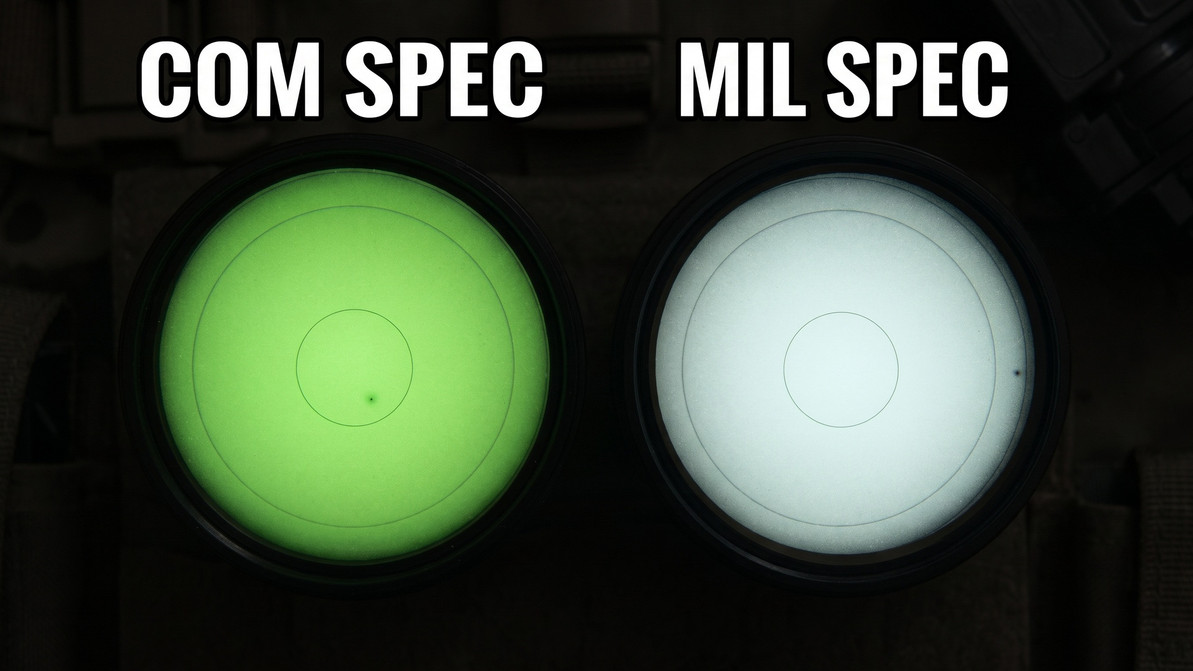
The Anatomy of a Night Vision Blemish: Why "Commercial Spec" Can Be a Massive Bargain
When diving into the world of night vision for the first time, buyers are often bombarded with technical jargon. Alongside terms like FOM and SNR, you will inevitably run into the designations "Mil-Spec" (Military Specification) and "Com-Spec" (Commercial Specification).
For many first-time buyers, the term "Com-Spec" or the mention of a "blemish" sounds like a massive red flag. They assume the tube is broken, low quality, or completely unusable. The reality? This assumption couldn't be further from the truth. Understanding how image intensifier tubes are graded by the factory is the secret to unlocking some of the absolute best values in the night vision market.
Let’s pull back the curtain on the manufacturing process, explain exactly what makes a tube "fall out" of military specifications, and why a Com-Spec unit might just be the smartest purchase you can make.
What is a Mil-Spec Tube?
To understand Com-Spec, you first have to understand Mil-Spec.
When a factory (like L3Harris or Elbit Systems of America) manufactures an image intensifier tube, it goes through a rigorous testing and grading process. Because tube factories fulfill a wide variety of contracts, there are hundreds of different image tube SKUs, and the exact specifications can vary.
A "Mil-Spec" tube simply means that the specific tube passed every single requirement dictated by a current, active government or military contract. In the civilian tactical market, when people say "Mil-Spec," they are generally referring to the prominent ground-based specifications:
- For L3Harris: The premier Mil-Spec standard is the 18UM contract spec, which adheres to the Omni 8 standard of a 1600 minimum Figure of Merit (FOM).
- For Elbit: The premier Mil-Spec standard is the YH contract spec, which requires a strict minimum Signal-to-Noise Ratio (SNR) of 25.0 and absolutely zero cosmetic spots in Zone 1 (the dead center of your field of view).
If a tube meets every single one of these rigid performance and cosmetic requirements, it receives its Mil-Spec grade.
The "Fall Out": Enter the Com-Spec Tube
Manufacturing night vision is a highly complex process. If a newly manufactured tube goes through testing and fails to meet any of the stringent requirements of a military contract, it "falls out" of the Mil-Spec category and is re-graded as Com-Spec.
Here is the critical takeaway: A tube can fall into Com-Spec over one tiny detail, or many.
Because there are various levels of Mil-Spec across hundreds of SKUs, there are corresponding levels of Com-Spec fall-outs. The most common Com-Spec grades you will encounter are direct fall-outs from the premier lines:
- L3Harris 1701: This is the direct Com-Spec fall-out grade from the L3 18UM line.
- Elbit SLH: This is the immediate fall-out grade from Elbit’s premium YH line. While the Mil-Spec YH demands a 25.0 minimum SNR, an SLH tube drops the minimum SNR slightly to 24.0. Crucially, like the YH, an SLH tube still does not allow any spots in Zone 1.
- Elbit XLSH: This is a grade heavily marketed in the civilian sector. XLSH is more of a fall-out than SLH (which is the grade directly above XLSH). The main difference is that an XLSH tube allows for a lower minimum SNR of 21.0 and, unlike the grades above it, it does allow for cosmetic spot(s) in Zone 1.
Understanding Zones and Blemishes
To understand why a tube falls out for cosmetics, you need to know how the factory divides your viewing area:
- Zone 1: The dead center of the image. (Military contracts are incredibly strict here).
- Zone 2: The mid-ring surrounding the center.
- Zone 3: The far outer edge of the image (your peripheral vision).
During manufacturing, microscopic particles of debris can get trapped inside the vacuum tube, creating tiny black "pepper spots."
Imagine a factory produces a phenomenal tube with a sky-high SNR and incredible resolution. However, it has one microscopic black pepper spot on the far outer edge of Zone 3. Because a military contract demands near-perfect cosmetics, that tiny spot on the periphery causes this absolute powerhouse of a tube to fail Mil-Spec grading. It can become a Com-Spec tube.
The Massive Bargain of Com-Spec
This grading process is exactly why Com-Spec tubes are highly sought after by educated buyers.
In many cases, a Com-Spec tube will perform at, or incredibly close to, the exact same level as a Mil-Spec tube. In many other cases, a Com-Spec tube’s actual raw performance can be greater than a baseline Mil-Spec tube; it simply fell out of grading because of a minor cosmetic blemish.
Let’s clear up the myths:
- Com-Spec tubes are not inherently worse for warranty.
- Com-Spec tubes do not have a shorter lifespan.
- Com-Spec tubes are not inherently lower performing in the dark.
Generally speaking, the primary trade-off you make when buying Com-Spec is accepting minor cosmetic defects (spots) within the viewable zones in exchange for significant cost savings.
If you are on a budget and don't mind a tiny black speck floating in your peripheral vision (which your brain naturally learns to look past anyway while moving or shooting), a Com-Spec or blemished tube allows you to harness incredible, top-tier Gen 3 performance for hundreds of dollars less than a “cosmetically perfect Mil-Spec unit.
Don't let the word "blemish" scare you away from a great deal. Shop with transparency and explore our inventory of hand-selected night vision systems at US Night Vision today.
Recent Posts
-
Bump vs. Ballistic Helmets: Ops-Core and Team Wendy Guide
Let's Talk About Helmets: Bump vs. Ballistic (What Do You Actually Need?)You’ve finally done it. You …28th Aug 2026 -
The AI Revolution in Night Hunting: Inside the Nocpix RICO 3 PRO H50R
For the last decade, the evolution of thermal imaging has been mostly a numbers game: higher resolut …27th Aug 2026 -
The Night Ops Ecosystem: What to Buy First—Night Vision, Thermal, or a Laser?
One of the most common—and most difficult—questions we field at US Night Vision is: "I finally have …13th Aug 2026