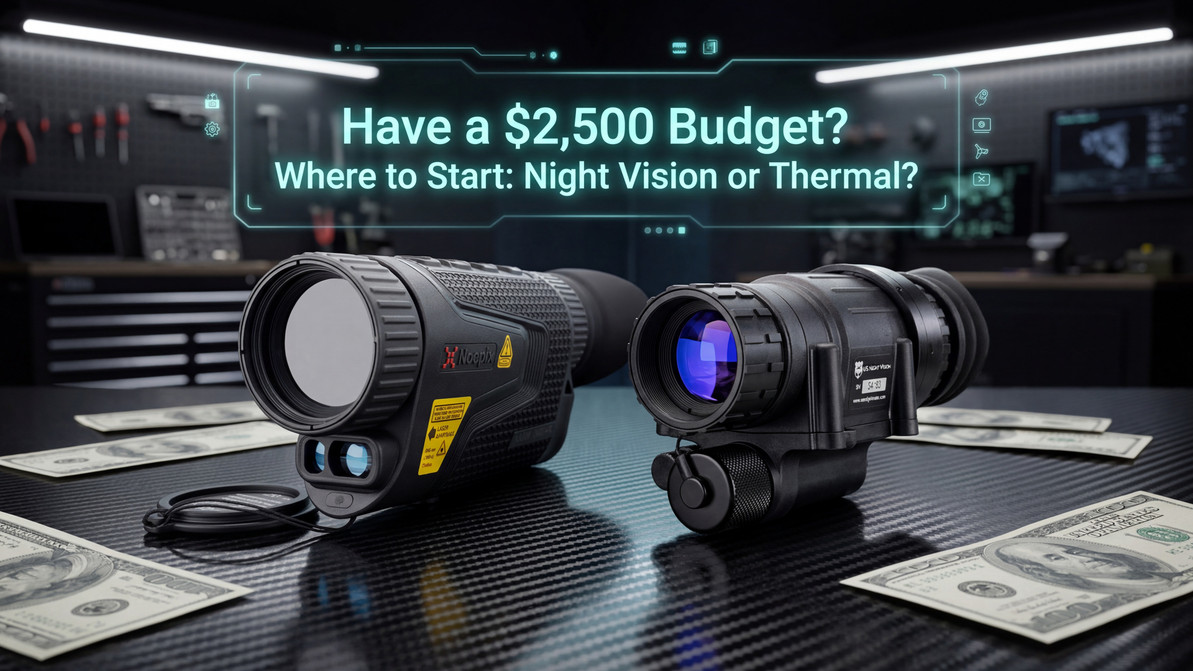
Have a $2,500 Budget? Where to Start: Night Vision or Thermal?
Title: Have a $2,500 Budget? Where to Start: Night Vision or Thermal?
"I finally have $2,500 to spend on seeing in the dark. Should I buy night vision or thermal?"
It is easily one of the most common questions we field at US Night Vision. First off, congratulations—$2,500 is the magic threshold. It is the exact budget where you officially step out of the realm of cheap, "toy-grade" digital junk and into serious, duty-grade equipment.
However, at this price point, you are faced with a decision to make. Depending on what you want to do, your money will either buy you a solid entry-level night vision monocular or a highly capable thermal device. Let’s break down which path is right for your needs.
The $2,500 Thermal Setup: The Ultimate Hunter At the $2,500 price point, the thermal market is your oyster for high-quality weapon scopes and handheld scanners.
- What you get: You can easily afford a dedicated thermal rifle scope or a premium handheld monocular with a crisp 384-resolution core.
- What it excels at: Absolute detection. Thermal is the undisputed king of finding targets. If your primary goal is hunting hogs, spotting coyotes, or doing property surveillance, thermal allows you to see heat signatures hundreds of yards away, right through thin brush, fog, or pitch blackness.
- The limitation: You cannot safely walk, drive, or navigate tough terrain using a thermal optic. Because thermal detects heat rather than light, you lose natural depth perception and fine environmental details. You will also be limited by the refresh rate of the thermal itself. This refresh rate will cause latency and for that it is not suggested to drive solely with thermal.
The $2,500 Night Vision Setup: The Tactical Navigator For $2,500, you are generally looking at a high-quality Gen 2+ or an entry-level/commercial-spec Gen 3 AN/PVS-14 monocular depending upon when you buy. Since the cost of night vision continues to rise the new entry level could be $4500 in a few short years! Read this to understand why night vision prices are on the rise.
- What you get: A reliable, mil-spec housing with an analog tube that amplifies ambient starlight and moonlight with zero latency (lag).
- What it excels at: Navigation, target identification, and fluid movement. If you want to hike in the dark, drive a UTV without headlights, or actively shoot using an infrared (IR) laser, you must have night vision. It operates just like your natural eye, providing a high-resolution view of the world.
- The limitation: If a target is perfectly camouflaged in the brush and not moving, night vision won't magically make them glow the way thermal does. You will also need to budget a bit extra down the road for a helmet and mount to use it hands-free.
The Verdict To put it simply: Night vision is for moving; Thermal is for finding.
- If your primary goal is predator hunting, eradication, or static surveillance, spend your $2,500 on Thermal.
- If your primary goal is tactical training, survival (SHTF) preparedness, or moving safely through the dark, spend your $2,500+ on Night Vision.
Ready to gear up? Shop Thermal Optics and PVS-14 Monoculars at US Night Vision today.
Recent Posts
-
Bump vs. Ballistic Helmets: Ops-Core and Team Wendy Guide
Let's Talk About Helmets: Bump vs. Ballistic (What Do You Actually Need?)You’ve finally done it. You …28th Aug 2026 -
The AI Revolution in Night Hunting: Inside the Nocpix RICO 3 PRO H50R
For the last decade, the evolution of thermal imaging has been mostly a numbers game: higher resolut …27th Aug 2026 -
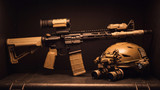
The Night Ops Ecosystem: What to Buy First—Night Vision, Thermal, or a Laser?
One of the most common—and most difficult—questions we field at US Night Vision is: "I finally have …13th Aug 2026